

BIOGRAPHY
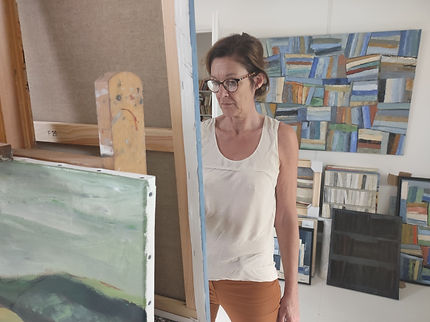
Born in Suresnes, near Paris, in 1964, Sophie Dumont is a French painter who lives and works in Langrune-sur-Mer, Normandy. Self-taught, she began painting in 1991 and gradually developed a practice informed by art history and by an ongoing exploration of material, color, and the construction of space.
Her work is organized around several complementary bodies of work: libraries, abstract landscapes, studios, and geometric and architectural compositions. Across these different series, she explores the relationships between memory, structure, light, and human presence.
Sophie Dumont works primarily in oil on canvas or linen, using both palette knife and brush. Her paintings are built through successive layers, sometimes incorporating gauze or subtle collage elements. Overpainting, scraping, erasure, and reworking allow earlier stages of the painting to remain visible, giving each surface its particular depth. Material is not simply a visual effect: it retains the memory of the creative process.
In the Libraries series, books are treated less as objects than as architectural forms and symbols of transmission. Their accumulation, verticality, and deliberate imbalances create silent spaces where knowledge, time, and memory intersect.
Geometric and architectural compositions now occupy a major place in her practice. Vertical lines, curves, circles, and planes of color are arranged according to precise, sometimes deliberately unstable balances. These forms may suggest figures, instruments, objects, or fragments of architecture without ever becoming explicitly figurative. Geometry is not approached as a rigid system, but as a sensitive visual language through which Dumont explores tension, rhythm, and gravity between forms.
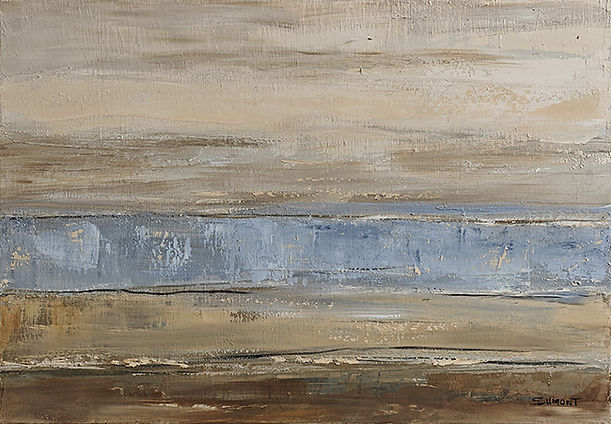
In her abstract landscapes, Sophie Dumont similarly works through simplification and accumulation. Horizon lines, expanses of color, and variations in texture evoke less an identifiable territory than the memory of a place, shifts in light, and the sensation of moving through space.
The literary dimension of her work has led several authors and publishers to select her paintings for book covers and publications. Her work has notably illustrated Le Format d’un livre by Michel Jullien, published by Éditions Verdier, and Aimer, enseigner by Yvon Rivard, published by Éditions du Boréal. Three of her paintings were also selected by the American magazine Plough Quarterly to accompany an article devoted to literature and education. Philosopher Lloyd P. Gerson, a specialist in Plato and Neoplatonism, selected one of her paintings for the cover of a book devoted to Plato.
Her work has been featured on France 3 Normandie, and several of her paintings have been selected for film productions. Her paintings have also been exhibited in several French museums.
Today, Sophie Dumont’s works are held in numerous private collections around the world, with a particularly strong presence in the United States.
ARTIST STATEMENT
Sophie Dumont’s painting develops over time. Each work emerges through a succession of layers, overpainting, and erasure, allowing the surface to retain traces of its transformations. Some colors disappear almost entirely, while others remain perceptible through a crack, a scraped area, or a transparent layer.
This method gives material a function comparable to memory: what has been covered never entirely disappears. The painting becomes a space in which several temporalities coexist.
In the Libraries series, books form interior architectures and evoke the transmission of knowledge, but also the fragility of what is preserved, classified, or forgotten. In the abstract landscapes, horizon lines and expanses of color convey less a specific place than a sensation of territory.
In the geometric compositions, construction becomes more assertive. Curves, verticals, circles, and colored masses come together, oppose one another, or are interrupted. Their arrangement may suggest a silhouette, an instrument, an architectural structure, or a presence, yet these associations remain open. Geometric rigor is continually disrupted by material, surface accidents, and the irregularities of the artist’s gesture.
Whatever the series, Sophie Dumont seeks to maintain a tension between construction and freedom, rigor and accident, abstraction and suggestion. Color acts both as a structural force and as a sensory presence. Deep blues, ochres, earth tones, muted pinks, reds, and broken whites interact through contrasts, densities, and their successive reappearances.
The work does not seek to impose a fixed narrative. Instead, it offers a space for contemplation in which material, color, and form allow a different memory and interpretation to emerge for each viewer.